
Frantoio olive variety – a world-famous italian certainty!
F r a n t o i o o l i v e v a r i e t y – a w o r l d - f a m o u s i t a l i a n c e r t a i n t y !

Frantoio olive oil – typically Italian – is famous all over the world
Frantoio is among the most praised, popular, and widespread olive varieties in the central areas of Italy.
Very well known throughout our country, it is now highly appreciated also abroad due to its high productivity and its constancy as well as for the ease with which it is mixed (blending process) with other olive oil varieties.
Indeed, the Frantoio, with its sweet and round notes, can balance many other olive oil varieties that alone would not have the same yield.


What are the characteristics of Frantoio olive oil?
Taste: on the palate it is aromatic, light but at the same time slightly spicy and savoury, with an aftertaste of almond and herbs. Simply delicious.
Aroma: Frantoio oil gives off scents of artichoke, fresh grass, and almond, all combined with a fruity component. An aroma that will make you fall in love with this olive variety!
Pairings: grilled meat, bruschetta, legume and vegetable soups, and for dressing fresh salads.

How is the Frantoio oil used in the Azienda Agricola Montioni?
Among the best pollinators of the Frantoio variety, there is Moraiolo – another typical Umbrian variety – which we also have in our land in Montefalco (PG).
This is the reason why Azienda Agricola Montioni has decided to produce an extra virgin olive oil with 50% of Moraiolo and 50% of Frantoio: a winning combination.
Making this type of blend (by mixing different olive oils, not 100% the same olive variety) creates a balanced taste, given by the spicier and stronger taste of Moraiolo olives combined with the lighter and sweeter taste of Frantoio olives.
> Our 50% Frantoio and 50% Moraiolo Extra Virgin Olive Oil is on sale online!

2) Aggiungere un cucchiaino di lievito per dolci, quindi amalgamare.
3) Foderare una teglia con carta da forno
4) Fare con l’impasto dei rotolini e poi unire i due estremi di ciascun rotolino per formare una ciambellina.

5) Ripassare la ciambellina nello zucchero, avanti e dietro, poi disporre sulla teglia.
6) Infornare le ciambelline a 190° per 7 minuti

Ed ecco pronte le nostre ciambelline al Sagrantino Passito Montioni!

L’abbinamento che vi consigliamo? Ovviamente un calice di Sagrantino Passito Montioni o, in alternativa, il nostro vino più amato ovvero il Sagrantino di Montefalco DOCG Montioni!
Alla prossima ricetta del blog dell’Azienda Agricola Montioni, Tra Cucina e Cantina!
On occasion, the winemaker may decide to leave them in if the grapes themselves contain less tannin than desired. This is more acceptable if the stems have ‘ripened’ and started to turn brown. If increased skin extraction is desired, a winemaker might choose to crush the grapes after destemming.
Wine is one of the most civilized things in the world and one of the most natural things of the world that has been brought to the greatest perfection, and it offers a greater range for enjoyment and appreciation than, possibly, any other purely sensory thing.
Ernest Hemingway Tweet
Removal of stems first means no stem tannin can be extracted. In these cases the grapes pass between two rollers which squeeze the grapes enough to separate the skin and pulp, but not so much as to cause excessive shearing or tearing of the skin tissues. In some cases, notably with “delicate” red varietals such as Pinot noir or Syrah, all or part of the grapes might be left uncrushed (called “whole berry”) to encourage the retention of fruity aromas through partial carbonic maceration.
The Grapes
The quality of the grapes determines the quality of the wine more than any other factor. Grape quality is affected by variety as well as weather during the growing season, soil minerals and acidity, time of harvest, and pruning method. The combination of these effects is often referred to as the grape’s terroir.
Grapes are usually harvested from the vineyard from early September until early November in the northern hemisphere, and mid February until early March in the southern hemisphere.
In some cool areas in the southern hemisphere, for example Tasmania, harvesting extends into May. The most common species of wine grape is Vitis Vinifera, which includes nearly all varieties of European origin. The most common species of wine grape is Vitis Vinifera, which includes nearly all varieties of European origin.

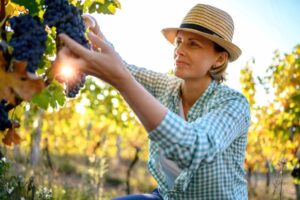
Manual harvesting is the hand-picking of grape clusters from the grapevines. In the United States, some grapes are picked into one- or two-ton bins for transport back to the winery. Manual harvesting has the advantage of using knowledgeable labor to not only pick the ripe clusters but also to leave behind the clusters that are not ripe or contain bunch rot or other defects. This can be an effective first line of defense to prevent inferior quality fruit from contaminating a lot or tank of wine.
Destemming is the process of separating stems from the grapes. Depending on the winemaking procedure, this process may be undertaken before crushing with the purpose of lowering the development of tannins and vegetal flavors in the resulting wine. Single berry harvesting, as is done with some German Trockenbeerenauslese, avoids this step altogether with the grapes being individually selected.
Crushing is the process when gently squeezing the berries and breaking the skins to start to liberate the contents of the berries. Destemming is the process of removing the grapes from the rachis (the stem which holds the grapes).
In traditional and smaller-scale wine making, the harvested grapes are sometimes crushed by trampling them barefoot or by the use of inexpensive small scale crushers. These can also destem at the same time. However, in larger wineries, a mechanical crusher/destemmer is used. The decision about destemming is different for red and white wine making. Generally when making white wine the fruit is only crushed, the stems are then placed in the press with the berries. The presence of stems in the mix facilitates pressing by allowing juice to flow past flattened skins.
Katerina Monroe
@katerinam • More Posts by Katerina
Congratulations on the award, it's well deserved! You guys definitely know what you're doing. Looking forward to my next visit to the winery!

