
Salt fish and Montioni Umbria Grechetto
S a l t f i s h a n d M o n t i o n i U m b r i a G r e c h e t t o
Welcome to the new space Between Kitchen and Cellar, the blog of the Azienda Agricola Montioni!
The first delicious recipe of our culinary competition in which anyone can send their culinary ideas, pairing them with Montioni wine or oil.
We cannot wait to know all your typical dishes, your culinary traditions, but also new recipes with the most curious ingredients.
With a good glass of wine from our cellar, every dish will be enhanced!
Let’s see the first recipe ent by Paolo, a cooking enthusiast from Bologna.
RECIPE: SALT FISH
Ingredients
– 700 gr fresh fish (sea bream, sea bass, red snapper, cow bream…)
– 1 Kg equally divided between fine salt and coarse salt
– 1 egg white
– 1 lemon zest
– various herbs and spices to taste (rosemary, thyme, sage, parsley…)
– Montioni extra virgin olive oil
Pairing Between Kitchen and Cellar
Montioni Umbria Grechetto I.G.T. White still wine, perfect to go with fish dishes like this one.
Method
Salt fish is a simple and tasty dish to cook, excellent paired with Montioni Grechetto I.G.T..
It can be made with the type of fish you prefer.
1) Fish must be cleaned and gutted, taking care not to eliminate the scales.
2) Place parchment paper onto a large baking tray and create a bed of coarse salt on top where clean fish will be laid.


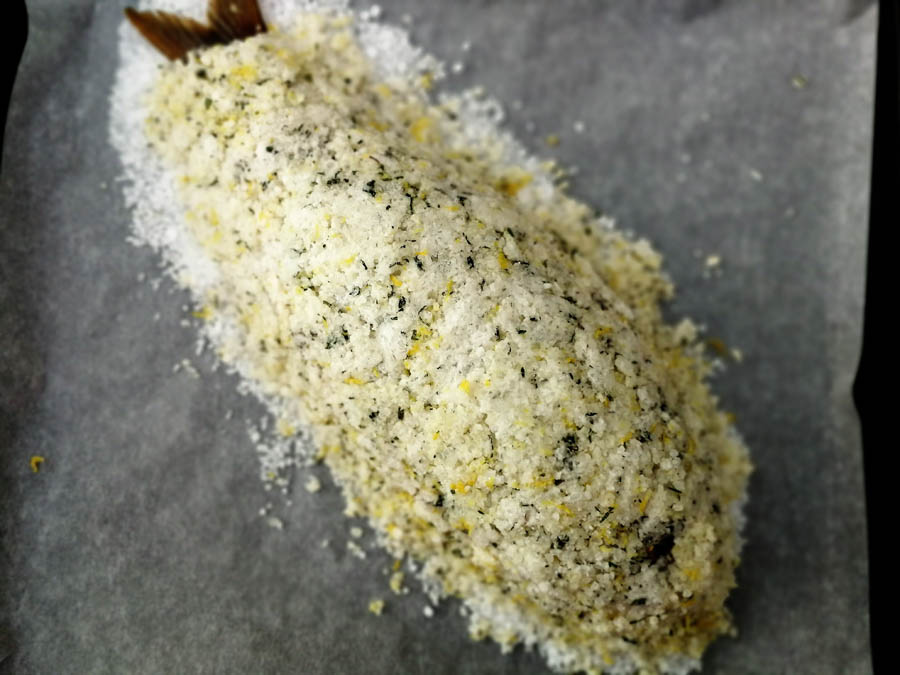
3) Whip the egg white until stiff in a mixing bowl, then add the finely chopped herbs and grated lemon zest.
4) Gently add the fine salt in order to get a uniform mixture.
5) Arrange the fish on the bed of coarse salt previously created, and completely cover it with the mixture just blended, so as not to leave any free space.
6) Place in a preheated oven at 400 °F for approx. 20-25 minutes.

7) When cooked, break the crust with a kitchen mallet and clean the fish of excess salt.

8) Get the portions, season with a drizzle of Montioni extra virgin olive oil to make the fish even softer and tastier.
Serve the dish with an excellent Montioni Umbria Grechetto I.G.T., perfect with fish, at a recommended temperature between 50 °F and 54 °F.

After a drizzle of Montioni extra virgin olive oil, the salt fish is ready to be enjoyed together with a good glass of Grechetto from the Montioni cellar!
Enjoy your meal!
We thank Paolo from Bologna for his tasty recipe and for creating the perfect match Between Kitchen and Cellar!
We look forward to seeing all your delicious pairings! Read the rules to send us your recipes here! qui!
On occasion, the winemaker may decide to leave them in if the grapes themselves contain less tannin than desired. This is more acceptable if the stems have ‘ripened’ and started to turn brown. If increased skin extraction is desired, a winemaker might choose to crush the grapes after destemming.
Wine is one of the most civilized things in the world and one of the most natural things of the world that has been brought to the greatest perfection, and it offers a greater range for enjoyment and appreciation than, possibly, any other purely sensory thing.
Ernest Hemingway Tweet
Removal of stems first means no stem tannin can be extracted. In these cases the grapes pass between two rollers which squeeze the grapes enough to separate the skin and pulp, but not so much as to cause excessive shearing or tearing of the skin tissues. In some cases, notably with “delicate” red varietals such as Pinot noir or Syrah, all or part of the grapes might be left uncrushed (called “whole berry”) to encourage the retention of fruity aromas through partial carbonic maceration.
The Grapes
The quality of the grapes determines the quality of the wine more than any other factor. Grape quality is affected by variety as well as weather during the growing season, soil minerals and acidity, time of harvest, and pruning method. The combination of these effects is often referred to as the grape’s terroir.
Grapes are usually harvested from the vineyard from early September until early November in the northern hemisphere, and mid February until early March in the southern hemisphere.
In some cool areas in the southern hemisphere, for example Tasmania, harvesting extends into May. The most common species of wine grape is Vitis Vinifera, which includes nearly all varieties of European origin. The most common species of wine grape is Vitis Vinifera, which includes nearly all varieties of European origin.

Manual harvesting is the hand-picking of grape clusters from the grapevines. In the United States, some grapes are picked into one- or two-ton bins for transport back to the winery. Manual harvesting has the advantage of using knowledgeable labor to not only pick the ripe clusters but also to leave behind the clusters that are not ripe or contain bunch rot or other defects. This can be an effective first line of defense to prevent inferior quality fruit from contaminating a lot or tank of wine.
Destemming is the process of separating stems from the grapes. Depending on the winemaking procedure, this process may be undertaken before crushing with the purpose of lowering the development of tannins and vegetal flavors in the resulting wine. Single berry harvesting, as is done with some German Trockenbeerenauslese, avoids this step altogether with the grapes being individually selected.
Crushing is the process when gently squeezing the berries and breaking the skins to start to liberate the contents of the berries. Destemming is the process of removing the grapes from the rachis (the stem which holds the grapes).
In traditional and smaller-scale wine making, the harvested grapes are sometimes crushed by trampling them barefoot or by the use of inexpensive small scale crushers. These can also destem at the same time. However, in larger wineries, a mechanical crusher/destemmer is used. The decision about destemming is different for red and white wine making. Generally when making white wine the fruit is only crushed, the stems are then placed in the press with the berries. The presence of stems in the mix facilitates pressing by allowing juice to flow past flattened skins.
Katerina Monroe
@katerinam • More Posts by Katerina
Congratulations on the award, it's well deserved! You guys definitely know what you're doing. Looking forward to my next visit to the winery!

